Drug Discovery
Predoctoral Fellowship
$30,000 a year for up to 2 years
The PhRMA Foundation Predoctoral Fellowship in Drug Discovery provides support for promising students (U.S. and non-U.S. citizens) in advanced stages of training and thesis research in drug discovery research.
New: Second 2027 Funding Cycle
For the first time in its 60-year history, the PhRMA Foundation is holding a second funding cycle in the same calendar year to award more predoctoral and postdoctoral researchers in 2027. This second cycle is part of the Foundation’s plans to expand its fellowship programs to fund 500 early-career researchers over the next three years, significantly increasing our investment in America’s future biomedical research workforce.
Letter of Intent Due: October 30, 2026, @ 12:00 p.m. ET (9:00 a.m. PT, 10:00 a.m. MT, 11:00 a.m. CT)
Key Dates

Letter of Intent Deadline

Invitation to Submit Full Application for Select Candidates
Full Application Deadline

Award Winner Notification
Program Vision
Drug discovery involves the innovative application and integration of multiple scientific disciplines to create efficacious, safe, and differentiated treatment options for patients. The PhRMA Foundation seeks to fund novel, early-stage, drug discovery research with a clear potential for translation to humans.
Scope of Research
Research areas could include, but are not limited to:
- Target identification and validation using genetic engineering (e.g., CRISPR-Cas9) and phenotypic screens (e.g., 3-D cell culture)
- Mapping disease mechanisms using single-cell and spatial multi-omics approaches to identify disease-relevant targets (e.g., scRNA-seq, spatial transcriptomics, spatial proteomics)
- Hit and lead identification with validation and molecular modeling (including structure-enabled discovery of novel drug modalities)
- Protein biochemistry and structural biology, including computational approaches
- Cellular and molecular biology approaches to elucidate therapeutically relevant pathways and mechanisms
- In vitro (cell-based) and in vivo (animal) studies that assess drug candidate pharmacological profiles (e.g., mechanism of action, effectiveness, safety and toxicity)
- Applications of advanced biomedical imaging in vitro (e.g., cellular high-content screening for target identification and validation) and in vivo (e.g., PET, MRI/CT for drug target engagement and biodistribution)
- Artificial intelligence (AI) and computational approaches that directly advance a therapeutic hypothesis
Requirements
All proposals must clearly state a therapeutically relevant hypothesis. Computational approaches must include a clear and feasible plan for translational validation to human-relevant systems. Proposals that involve AI approaches (i.e., data-driven ML/DL) must clearly document and reference the methodology, explain the data curation process (sources, quality, quantity), and detail the validation process.
Nonresponsive
Projects that focus exclusively on single aspects such as pure assay development, chemistry-only projects without therapeutic evaluation, or biomarker or diagnostic identification without clinical context will not be considered.
Note: Please ensure you are applying to the correct PhRMA Foundation program. If your project does not align with the goals of the Drug Discovery Program, as outlined above, please review the Foundation’s Drug Delivery and Translational Medicine programs to see whether your project fits into one of those programs. Contact the Foundation (info@phrmafoundation.org) with your project description if you need further clarification.
FOR THE SECOND 2027 FUNDING CYCLE:
- Applicants (U.S. and non-U.S. citizens) must attend an accredited U.S. university as full-time, in-residence students.
- Individuals just beginning graduate school should not apply. Applicants must have completed all qualifying exams by February 28, 2027.
- Applicants who expect to complete their PhD before August 1, 2028, are ineligible.
- Applicants who have not authored a publication or presented a poster are ineligible.
- Applicants enrolled in MD/PhD programs should not be engaged in required clinical coursework or clerkships while the fellowship is active. Fellows are expected to devote full time (including summers) to their research.
- Applicants currently funded on an institutional training grant (e.g., NIH TL1, T32, T90, or T35 awards or a nonprofit/professional society equivalent) may apply if they state they will forgo the institutional training slot if funded by a PhRMA Foundation predoctoral award.
- Applicants are ineligible if they are the recipient of an NIH-F award.
- An individual may not simultaneously hold another funding mechanism providing stipend support while the PhRMA Foundation predoctoral fellowship is active. If necessary, the university may supplement the Foundation’s award to a level that is consistent with other predoctoral fellowships it offers.\
- The predoctoral fellowship is not intended to fund work already supported by a principal investigator’s active grants.
- Only one applicant per lab may apply in the Drug Discovery Program. Labs must select either a predoc or a postdoc.
- If an applicant has previously submitted an LOI to the PhRMA Foundation but was not invited to submit a full application, they may not resubmit the same LOI. To be eligible, the applicant must propose a new or substantially revised research project that shows improvement in scope, aims, methodology, or scientific rationale.
FOR THE SECOND 2027 FUNDING CYCLE:
- The PhRMA Foundation Predoctoral Fellowship in Drug Discovery provides $30,000 in stipend support per year for 12, 18, or 24 months.
- To receive funding beyond the first 12 months, awardees must provide the PhRMA Foundation with a satisfactory progress report upon completion of the first 10 months of funding. In addition, awardees must provide a letter from their thesis advisor confirming that satisfactory progress is being made.
- Funding is conditional upon the awardee’s continued enrollment with the university, which will be assessed on a quarterly basis prior to payment.
- Payments will be made directly to the university on behalf of the awardee, with the understanding that the university will administer the funds.
- This award is intended solely as a stipend and may not be used otherwise. Funds may not be used for tuition, fringe benefits, or indirect costs to the university.
- Within the yearly award amount of $30,000, up to $1,000 per year may be used for incidentals directly associated with thesis research preparation or travel to a scientific conference in the United States.
- Funding may begin as early as August 1, 2027, or on the first day of any month thereafter, up to and including December 1, 2027.
- A financial report (separate from the 10-month progress report) will be required upon completion of the first 12 months of funding.
- A final progress report and financial report will be required within 60 days of the fellowship’s conclusion.
- Unspent funds are to be returned to the PhRMA Foundation.
- Any changes to the proposed project must be approved by the PhRMA Foundation.
- These funds are non-transferable.
FOR THE SECOND 2027 FUNDING CYCLE:
This is a two-step process. Step one is submitting a letter of intent (LOI) by October 30, 2026, at 12:00 p.m. ET (9:00 a.m. PT, 10:00 a.m. MT, 11:00 a.m. CT). If your LOI is accepted, you will be notified in mid-February 2027 that you should apply. Details about the application process and deadline will be available at that time.
To start a letter of intent, go to the ProposalCentral website at proposalcentral.com. If you are a new user of ProposalCentral, follow the link “Create an Account” and complete the registration process. If you are already a registered user, login with your username and password. If you have forgotten your password, click the “Forgot your Password?” link.
Once you are logged in, please click the “Professional Profile” tab at the top and complete steps 1-11 or update with your current information. Your name, degrees, position/title, academic rank, department, and address will be pulled from this page in ProposalCentral.
Step 1: Letter of Intent (LOI)
The applicant must have primary responsibility for the writing and the preparation of the application, understanding the mentor/thesis advisor will play a significant part in providing guidance to the applicant.
To submit an LOI, select the “Grant Opportunities” tab in ProposalCentral and a list of applications will be displayed. Find “PhRMA Foundation” and click the “Apply Now” link next to the Predoctoral Fellowship in Drug Discovery Program.
Candidates are required to submit the following items at this stage:
1. NIH Biosketch
Use the new SciENcv format. Be sure to include your papers and poster presentations. Do not include scholastic performance.
2. Project Abstract
3. Letter of Intent
The LOI must be written by the applicant and should describe the research project, its aims, and its hypotheses. Include in-line citations. The lay summary will be entered directly into ProposalCentral and cannot exceed 4,500 characters, including spaces. The first use of any abbreviation or acronym should be preceded by the full name or description.
One attachment is allowed for figures (maximum of 4) and references. Figure descriptions should not exceed three sentences. These do not count toward the 4,500-character limit. This attachment should be on U.S. letter sized 8.5” x 11” page with .5” margin and 11-point font. The attachment cannot exceed two pages and must be combined into a PDF.
4. Research Impact Questions
Provide responses to the Research Impact Questions using the template provided in Proposal Central.
- Explain how your project fits into the PhRMA Foundation’s Drug Discovery Program.
- What is the specific hypothesis/hypotheses you aim to test?
- What is the therapeutic relevance of the question you aim to address, and how is your project an innovative way to address it?
- Explain how your project could advance drug development within five years of publication.
LOIs are due by October 30, 2026, at 12:00 p.m. ET (9:00 a.m. PT, 10:00 a.m. MT, 11:00 a.m. CT).
Step 2: Full Application (by invitation)
Those whose LOIs are selected will be notified by mid-February 2027 and asked to complete a full application. The full application deadline will be shared upon invitation.
To submit a full application, please complete and/or review for accuracy the following sections in ProposalCentral. Submissions that do not meet the requirements will not be considered.
Section 1: General Information
On this page, enter your project title and how much funding you are seeking.
Section 2: Download Templates and Instructions
Use this page to download copies of the program instructions, as well as templates that you must use for the Research Impact Questions and Training Plan.
Section 3: Applicant
The information you provided in the LOI stage will remain in your historical data in ProposalCentral. If needed, update your Professional Profile to include your degrees and a biosketch, as these are required to complete this page of the proposal.
Section 4: Institution Details
The information on this page will be populated from the institutional profile in ProposalCentral’s database. If any information is missing or incorrect, contact the PC Support Team at pcsupport@altum.com or 800-875-2562 (Monday-Friday 8:30 a.m.- 5:00 p.m. Eastern Time).
Section 5: Key Personnel
Use this page to add any Key Personnel to your project. Adding them on this page does not grant them access to your proposal — that must be done on the “Enable Other Users to Access This Proposal” page.
You are required to add a Department Chair, Thesis Advisor, Thesis Chair, and collaborators (if any). If any person fulfills multiple roles, add their information in each section.
Section 6: Letters of Reference
The system will NOT accept your application unless the letters of support from your references have been successfully uploaded.
You are required to submit contact information for the following personnel:
- Thesis Advisor (up to 2 references)
- General References: 1-3 people who are familiar with you and your scientific career
- Collaborators: If you have collaborators, they must submit a letter of support. Each collaborator (up to 2) should submit their own letter of support. If you have 3 or more collaborators, they should co-write one letter of support with all their signatures. The person responsible for coordinating this group letter is the name you should enter in this section.
Once you add their names and contact information to your application, an auto-generated email will be sent to them with instructions on what they should address in their letter of support and a personalized hyperlink where they should upload their letter.
We suggest you inform your references in advance of what to include in their letter of support.
Thesis Advisor requirements:
- Assessment of the applicant, including their progress, achievements, publication/presentation record, interpersonal and communication skills, etc.
- Confirmation of their doctoral candidacy. If it is pending, please note the anticipated date of doctoral candidacy.
- Description of the applicant’s scientific question and how they came up with the idea.
- The advisor’s NIH biosketch, attached to the letter as an appendix.
General Reference requirements:
- The time period for which they have known the applicant and in what capacity.
- Comment on the applicant’s communication and interpersonal skills, and ability to collaborate with peers on research projects.
- Explanation of how this program will be a productive experience for the applicant and why they should be selected.
- If involved in the applicant’s project, an explanation of their roles and responsibilities regarding the project.
Collaborator Reference requirements:
- Explanation of their involvement and responsibilities with the project.
- The collaborator’s CV or biosketch, attached to the letter as an appendix.
Section 7: Additional Questions
Answer all questions on this page. Be sure your bibliography page is up to date with publications and presentations.
Section 8: Abstract and Keywords
Enter your abstract (written for a broad scientific audience) and keywords. Take heed of the character limit for the abstract.
Section 9: Budget Summary
Enter your project dates and requested stipend support (e.g., are you requesting, 12, 18, or 24-months of funding). This should match what you entered in Section 1 “General Information.”
Section 10: Organization Assurances
Respond to the questions on this page regarding your IRB and IACUC approval.
Section 11: Attachments
Ensure your name and institution are noted at the top of each attachment.
- Applicant’s NIH-Style Biosketch (required)
You will have submitted this under the “Applicant” section. Do not include your academic record. - Extended Letter (required)
Include a synopsis of your career, professional interests, and desired career path. The letter should not exceed two single-spaced pages (U.S. letter size 8.5” x 11” / .5” margin / 11-point font). - Research Plan (required)
Applicants must prepare a comprehensive yet concise research plan. This should be written by the applicant and not copied from another’s project. Applicants should use a format similar to that for NIH grants. The research plan should include a specific aims page (one-page limit), followed by your research strategy (not to exceed six pages) that describes the rationale, significance, research design and methodology, statistical plan, timeline, and preliminary results (if any exist). A bibliography of major references should also be included. Bibliographies are not included in the seven-page limit (one for the aims page and six pages for the research strategy). Required type specifications: U.S. letter size 8.5” x 11” / .5” margin / 11-point font (figures may be provided in a smaller font). The first use of any abbreviation or acronym should be preceded by the full name or description. Submissions that do not meet the specified guidelines for proposal preparation will not be considered.
- Research Impact Questions (required)
Please respond to the research impact questions using the template provided. - Training Plan (required)
Use the template provided under Section 2 “Instructions and Templates.” The Training Plan must be signed by the applicant and advisor. There is no page limit.
Section 12: Demographics
Responses on this page are confidential.
Section 13: Enable Other Users to Access This Proposal
Use this page to grant access to your proposal to any other users in the system.
- “Administrator” level permissions allow them full control of the proposal.
- “Edit” level permissions allow them to edit the proposal, but not delete it.
- “View” level permissions allow them to view the proposal but not make any changes.
Section 14: Validate
By clicking “Validate” on this page, the system will check your application for any missing or incomplete information.
Section 15: Print Application and Signatures
On this page, you will be able to print a recap of your application. As the applicant, by e-signing this application, you agree that you completed the application yourself. This is required for submission.
If you have given someone at the institution “Edit” access because they need to sign your application, they will e-sign in this section once you have completed your application. This needs to be completed before you “submit” your application.
Note: The PhRMA Foundation does not require anyone other than the applicant to e-sign the application, but your institution may require it.
Section 16: Submit
Do not forget to review your application before you “submit.”
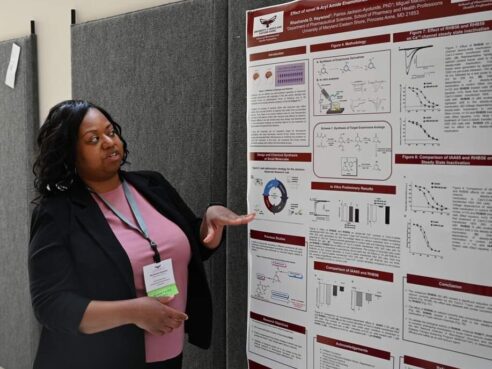
Receiving the PhRMA Foundation Predoctoral Fellowship is truly a professional and personal achievement. This support will allow me to continue my efforts in drug discovery research to address the need for novel anti-seizure agents.